


Quick Answer
Food grade grease is made up of three main components: a lubricating base oil, a thickener that transforms the oil into a semi-solid grease, and performance additives that enhance properties such as oxidation resistance, corrosion protection, wear resistance, and adhesion. The National Lubricating Grease Institute (NLGI) recognises these three components as the fundamental building blocks of lubricating grease. Meanwhile, U.S. FDA regulations specify the substances and limitations of use that apply to lubricants intended for incidental food contact.
It is important to note that ‘food grade’ does not mean ‘edible’. Rather, it means that the lubricant is formulated for use in food-related environments where there is a potential for incidental contact with food, provided that the applicable requirements are met. NSF H1 registration is commonly used for lubricants intended for use in applications involving potential incidental food contact.
What Is Food Grade Grease?
Food-grade grease is a semi-solid lubricant designed for use in machinery in food, beverage, pharmaceutical, and animal feed processing environments, where conventional industrial lubricants could pose an unacceptable risk of contamination. Its primary mechanical function is the same as that of other lubricating greases: it reduces friction and wear, and protects metal surfaces from corrosion. It also stays in place around bearings, gears, chains, bushings, slides, seals and other moving components.
However, what distinguishes food-grade grease is not simply its colour, texture, or marketing description. The formulation must consider the possibility that a small amount of lubricant could unintentionally come into contact with food or food-contact areas. In the United States, 21 CFR 178.3570 sets out the requirements for lubricants that come into contact with food and lists the permitted substances, along with the limitations on the concentrations or applications of certain ingredients.
Therefore, there is no universal chemical formula for food-grade grease. One product may use highly refined mineral oil, while another may use a synthetic base fluid such as polyalphaolefin (PAO). Different products may also use aluminium complex, calcium-based, polyurea, or other thickener technologies, with additives selected according to the required temperature range, water resistance, load capability, corrosion protection, and service life. Similarly, NLGI describes lubricating grease as a combination of lubricating fluid, thickener, and performance-enhancing additives, rather than as a fixed formulation.
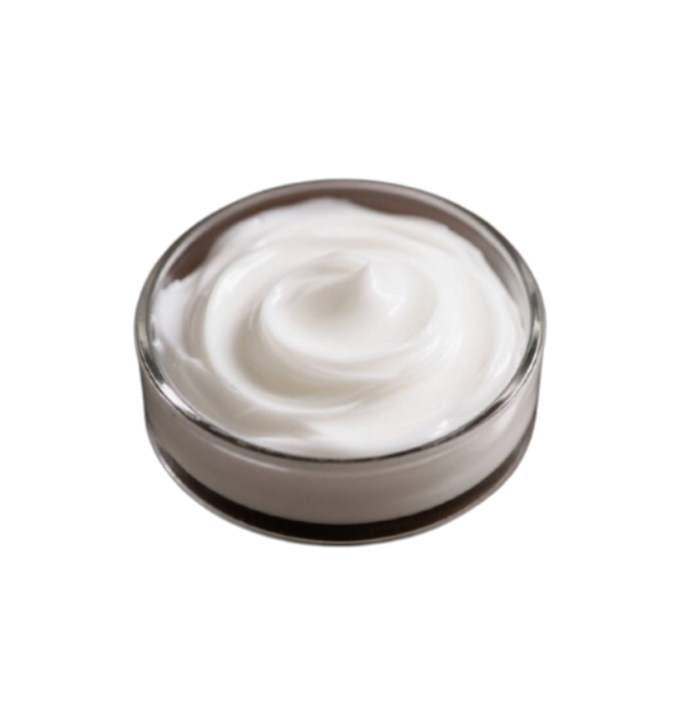
The Three Main Ingredients in Food Grade Grease
Understanding the composition of food grade grease becomes much easier when the formulation is separated into its three functional components.
| Grease Component | Typical Role | Examples / Considerations |
| Base oil | Provides the primary lubricating film | Mineral oil, PAO, synthetic or vegetable-derived fluids |
| Thickener | Holds the oil in a semi-solid structure | Soap-based or non-soap systems such as aluminum complex, polyurea, clay or silica |
| Additives | Fine-tunes performance | Antioxidants, corrosion inhibitors, anti-wear agents, extreme-pressure additives, tackifiers |
NLGI explains that the lubricating fluid is normally the majority component of grease, while the thickener provides the semi-solid consistency that distinguishes grease from liquid lubricants. Additives are generally present in smaller quantities and are selected to enhance specific performance characteristics.
This three-part structure is particularly useful when comparing food grade grease products. Rather than asking only whether a grease is “food safe,” a purchaser should also determine what base oil it contains, what thickener system is used, which additives are present, what certification or registration applies, and whether the resulting formulation matches the machinery’s operating conditions.
Base Oil: The Main Lubricating Component
The base oil is arguably the most important component in any grease formulation, as it forms the fluid that creates the lubricating film between moving surfaces. According to the technical glossary of the National Lubricating Grease Institute (NLGI), grease base fluids can include petroleum-derived mineral oils, synthetic fluids, or vegetable-based fluids.
For food processing applications, highly refined mineral oils are still important because they offer a practical balance of cost, availability, viscosity, and lubrication performance. Synthetic base oils are also used where the equipment requires a wider temperature range, lower volatility, improved oxidation resistance or other specialised properties. Ultimately, the choice is determined by the machinery rather than by the phrase ‘food grade’ alone.
Óleo Mineral
Highly refined mineral oil can be used as the lubricating fluid in certain food-grade formulations when the formulation complies with the applicable requirements. U.S. FDA 21 CFR 178.3570 specifically includes mineral oil among substances permitted for lubricants with incidental food contact, subject to the regulation’s limitations.
Mineral-oil-based food grade grease is often attractive for general industrial lubrication because it can provide predictable viscosity behavior without the cost associated with some specialty synthetic formulations.
Synthetic Base Oils
Synthetic base fluids can be selected when machinery operates at particularly high or low temperatures, experiences demanding loads, or requires extended lubrication intervals. Examples of synthetic lubricant families include PAO, synthetic esters, silicone fluids, and other specialty fluids, although the suitability of a particular chemistry must always be established from the finished lubricant’s formulation and applicable food-contact requirements rather than assumed from the base-fluid name alone.
NLGI’s grease glossary classifies PAO as an API Group IV base fluid and places other synthetic fluids, including synthetic esters and silicone oils, within Group V.
Why Base-Oil Viscosity Matters?
The viscosity of the base oil should not be confused with the NLGI grade of the finished grease. NLGI specifically notes that base-fluid viscosity and grease consistency are generally independent properties: the former concerns the lubricating fluid, while the latter is primarily determined by the thickener type and concentration.
This distinction is important in equipment selection. A grease can have the right NLGI consistency but still contain a base oil with an unsuitable viscosity for a high-speed bearing, heavily loaded gear, or low-temperature application.
Thickener: What Turns Oil Into Grease?
The second major component is the thickener. While the base oil provides the lubricating fluid, the thickener creates the structure that holds the oil in place.
The National Lubricating Grease Institute (NLGI) describes grease manufacturing as the process of dispersing the thickener throughout the lubricating fluid to create a stable semi-solid product. In many conventional greases, the thickener is formed through a chemical reaction between fatty acids and alkaline compounds, producing an organic salt commonly known as a soap. Other formulations use pre-reacted or non-soap thickening materials.
This structure explains why grease behaves differently from ordinary lubricating oil. When grease is applied to a bearing, for example, it tends to remain around the lubricated area rather than flowing away immediately. The thickener acts as a framework that retains the base oil, enabling it to perform the actual lubrication.
Common Thickener Technologies
Food grade grease can use different thickener technologies depending on its intended application and formulation requirements. Examples include aluminum complex, calcium-based systems, polyurea, bentonite/clay, and other permitted thickening systems. NLGI’s glossary identifies metallic soaps as common grease thickeners and also describes non-soap systems such as polyurea, calcium sulfonate, bentonite, and silica.
The thickener influences important properties such as consistency, mechanical stability, water resistance, temperature behavior, and the grease’s ability to stay in position. However, it is a mistake to assume that one thickener is universally better than another. The correct choice depends on bearing speed, load, operating temperature, water exposure, cleaning procedures, and compatibility with the existing lubricant.
Additives: Small Amounts With a Major Job
The third component consists of performance additives. Although these materials are generally used in much smaller concentrations than the base oil, they can have a significant impact on the finished grease.
The National Lubricating Grease Institute (NLGI) identifies antioxidants, corrosion inhibitors, anti-wear additives, and extreme-pressure additives as common categories of additives used to modify grease performance.
Selecting additives for food-grade grease requires additional care, as not every additive commonly used in general industrial grease is automatically appropriate for incidental food contact. U.S. FDA regulations list numerous permitted substances and impose specific restrictions on some of them, including maximum concentrations or limitations on their function.
| Additive Type | Purpose in Grease | Why It Matters in Food Processing |
| Antioxidant | Slows oxidation and lubricant degradation | Helps extend service life under heat and oxygen exposure |
| Corrosion inhibitor | Protects metal surfaces | Important in wet or washdown environments |
| Anti-wear additive | Reduces surface damage under load | Protects bearings and sliding contacts |
| Extreme-pressure additive | Helps protect under severe loading | Useful for demanding mechanical contacts |
| Tackifier | Improves adhesion and cohesion | Helps grease remain in place |
| Rust preventive | Limits corrosion caused by moisture | Useful around frequent cleaning and water exposure |
The important point is that the additive package must be evaluated as part of the complete formulation. A product cannot be considered suitable for incidental food contact merely because its base oil appears acceptable.
Is Food Grade Grease Made From Food Ingredients?
No, this is one of the most common misconceptions about the term.
Food-grade grease is not an edible lubricant. It is a technical lubricant designed for use with machinery in food production environments, and its formulation and usage requirements are intended to minimise the potential consequences of incidental contamination.
For instance, bearings in a food-processing machine may be located above a conveyor belt carrying packaged or unpackaged food. Under normal operating conditions, the grease should remain inside the bearing. However, a seal failure, excessive lubrication, vibration, pressure, or maintenance error could potentially cause a small amount of lubricant to escape.
The purpose of an appropriate food-grade lubricant is to ensure that, should such incidental contact occur, the lubricant meets the relevant requirements. The FDA’s regulations specifically refer to lubricants used on machinery involved in the production, processing, packaging, transportation, or storage of food, and set out conditions for incidental food contact.
Therefore, phrases such as ‘food-safe grease’, ‘food-grade lubricant’, and ‘edible grease’ should not be treated as synonyms automatically. The correct technical question is whether the particular product is approved, registered, or otherwise compliant for the intended application.
What Does NSF H1 Mean?
The NSF H1 classification is one of the most recognisable in the field of food-processing lubricants. According to NSF, H1 lubricants are intended for use in situations where they may come into contact with food.
This distinction is useful because food-processing plants may contain many different lubrication points, not all of which have the same contamination risk. For example, a lubricant for a component physically separated from food may be subject to different requirements than one used directly above an exposed product zone.
Purchasing teams should verify the actual product registration and intended use rather than relying on a generic statement such as ‘food grade’. Before approval, the product’s technical data sheet, safety documentation, certification or registration information, and plant sanitation requirements should all be considered.
How Is Food Grade Grease Manufactured?
Although the specific formulations vary, the general manufacturing concept is straightforward. The base oil and thickener are combined under controlled conditions to create the desired grease structure. Then, additives are incorporated, and the mixture is processed to achieve uniformity.
In the case of soap-based grease, the thickener can be generated in the lubricating oil through a controlled chemical reaction. According to NLGI, fatty acids and alkaline hydroxides can react to form soap-thickener structures, with water produced as a by-product. Other grease technologies rely on dispersing a pre-formed thickener rather than creating it through the same chemical reaction.
Once the basic grease structure has been formed, the product may undergo controlled cooling, homogenisation, milling, deaeration, filtration and other finishing processes. These steps influence the final consistency and structure. Therefore, the manufacturing process is not simply a matter of mixing oil with a powder, as the microstructure of the thickener network significantly influences how the finished grease behaves.
Quality control typically includes measurements such as NLGI consistency and dropping point, along with tests appropriate to the intended application. According to NLGI, consistency is measured using cone penetration methods such as ASTM D217/ISO 2137, while the dropping point can be evaluated using ASTM D2265 or ISO 2176.
What Does NLGI Grade Mean?
The NLGI grade indicates the consistency, or relative firmness, of grease. However, it does not indicate whether a grease is food grade, can withstand a particular temperature, or is suitable for a specific bearing.
The NLGI consistency scale ranges from the very soft grade 000 to the very hard grade 6, with NLGI 2 being a common consistency for general-purpose greases. However, the appropriate grade depends on the lubrication system and operating conditions.
This distinction is especially useful when comparing food-grade grease products. Two products can both be NSF H1 registered while having different NLGI grades, base oils, thickener systems, and performance characteristics.
In other words:
Food-contact classification tells you about the product’s suitability for the application.
The NLGI grade indicates grease consistency.
Base-oil viscosity indicates the lubricating fluid.
Thickener chemistry determines the grease structure and many of its physical properties.
These specifications should be considered together rather than as interchangeable.
Why Water Resistance Is Important in Food Processing?
Food-processing equipment is often exposed to water, detergents, steam, condensation, and frequent wash-down procedures. These conditions can pose a particular challenge to grease, as water can interfere with the lubricant’s structure and contribute to corrosion.
Therefore, a suitable food-grade grease needs to offer more than just compliance with food-contact regulations. It must also maintain effective lubrication under the actual operating and cleaning conditions of the equipment.
This is one reason why selecting the right thickener is important. Different thickener structures respond differently to water and mechanical working. The National Lubricating Grease Institute (NLGI) notes that grease properties are strongly influenced by the type and concentration of the thickener, and technical literature also shows that the structure of the thickener and the base oil influence characteristics such as tackiness and mechanical behaviour.
Therefore, for a conveyor or bearing exposed to aggressive washdown, the lubricant specification should include water resistance rather than simply requesting “food-grade grease”.
How Do You Choose the Right Food Grade Grease?
A good selection process starts with the machine, not the lubricant label. Before purchasing food-grade grease, the maintenance and engineering teams should identify the bearing or component in question, as well as its operating speed, load, temperature range, exposure to water, re-lubrication interval, and application location.
The next step is to verify the lubricant’s food-contact classification and technical specifications. If there is a possibility of incidental contact, confirm that the product is actually appropriate for that risk category, and check the manufacturer’s documentation rather than relying solely on a distributor’s description.
A practical selection checklist looks like this:
Identify the lubrication point. Determine whether it is a bearing, chain, gear, slide, seal, or another component.
Determine the operating temperature. Consider both normal and peak temperatures.
Check the speed and load. Bearings operating at high speeds may require different base-oil characteristics than those operating at low speeds and under heavy loads.
Evaluate water exposure. Consider washdown, steam, condensation, and cleaning chemicals.
Confirm the required food-contact classification. Verify the actual registration or compliance documentation.
Check the NLGI consistency. Match the grease grade to the equipment manufacturer’s recommendation.
Review compatibility. Do not assume that two different grease chemistries can be safely mixed.
Establish the relubrication procedure. Applying more grease is not necessarily better; overgreasing can create heat and mechanical problems.
Document the lubricant. Keeping a controlled list of lubricants helps to prevent the accidental substitution with an unsuitable industrial product.
Food Grade Grease vs. Conventional Industrial Grease
The primary difference is not that food grade grease necessarily provides superior lubrication. A conventional industrial grease can sometimes outperform a food grade product in a particular mechanical application because it has a wider choice of additives or a formulation optimized solely for mechanical performance.
The distinction is that food grade grease has to satisfy an additional contamination-control requirement when used in environments where incidental food contact is possible.
| Characteristic | Graxa de Grau Alimentício | Conventional Industrial Grease |
| Primary purpose | Lubrication plus contamination-risk control | Mechanical lubrication |
| Base oils | Mineral or selected synthetic fluids | Broad range of mineral and synthetic fluids |
| Thickeners | Application- and compliance-dependent | Very broad selection |
| Additives | Must be appropriate for intended food-contact category | Broad additive selection |
| Typical environment | Food, beverage, pharmaceutical processing | General industrial machinery |
| Incidental food contact consideration | Yes, where applicable | Not necessarily |
| NLGI grade | Available in different grades | Available in different grades |
| Selection priority | Compliance + mechanical performance | Mechanical performance + cost |
This is why replacing a conventional grease with a food grade grease should not be done solely by comparing NLGI grade. The base oil, thickener, additives, operating conditions, compatibility, and certification status all need to be considered.
Common Applications of Food Grade Grease
Food-grade grease can be used on a wide range of equipment, provided the specific product is suitable for the application. Typical lubrication points include conveyor bearings, food-processing machinery, packaging equipment, mixers, filling machines, bottling equipment, ovens, freezers, gear mechanisms, chains, slides and other moving components.
Using the correct grease is particularly important in areas where lubrication points are located above exposed food or close to product-contact zones. The potential consequences of lubricant leakage are much greater in these circumstances than in an isolated mechanical room.
However, the term ‘food processing equipment’ covers a wide range of operating conditions. For example, a freezer bearing, a high-temperature oven bearing, a high-speed bottling machine bearing and a washdown conveyor bearing can have completely different lubricant requirements. Therefore, the term ‘food grade grease’ identifies the application environment rather than a universal performance specification.
Can Food Grade Grease Be Mixed With Other Greases?
Assuming that different greases are compatible simply because they are both marketed as food grade is generally unwise.
Compatibility can be affected by factors such as the thickener chemistry, base oil, and additives used, as well as the grease’s physical structure. Mixing incompatible products can result in softening, hardening, oil separation, reduced mechanical stability, or a loss of lubrication performance.
The safer approach for a production facility is to identify the existing lubricant before changing products and consult the grease manufacturer regarding compatibility. If a complete changeover is necessary, the lubrication system may need to be cleaned or purged in accordance with the instructions provided by the equipment and lubricant manufacturers.
This is another reason why a controlled lubricant management programme is valuable in food manufacturing. Standardising approved lubricants can reduce the risk of accidental mixing and make maintenance records easier to audit.
FAQ About Food Grade Grease
- Do que é feito a graxa de grau alimentício?
Food grade grease is generally composed of a base oil, a thickener, and performance additives. The exact chemistry varies according to the product and intended application.
- Is food grade grease safe to eat?
No. Food grade grease is not an edible product and should never be intentionally consumed. It is formulated for machinery where incidental food contact may occur under defined conditions.
- What is the difference between food grade grease and regular grease?
Food grade grease is formulated and evaluated for use in environments where incidental food contact is a potential concern. Regular industrial grease is primarily optimized for mechanical lubrication and may not meet the requirements applicable to food-processing environments.
- Is NSF H1 grease food safe?
NSF H1 identifies lubricants intended for applications where incidental food contact may occur. It does not mean the grease is edible or intended for direct food contact.
- What oil is used in food grade grease?
Food grade grease can use highly refined mineral oil or selected synthetic or other permitted base fluids, depending on the formulation. The finished product—not simply the base oil—must meet the requirements applicable to its intended use.
- Can food grade grease be used in any food-processing machine?
No. The grease must also match the machine’s temperature, speed, load, water exposure, material compatibility, and lubrication requirements. Food-contact classification alone does not guarantee mechanical suitability.
Conclusion: What Is Food Grade Grease Really Made Of?
The simplest, most accurate answer is that food-grade grease is made from a lubricating base oil, a thickener, and performance additives. However, this description only tells part of the story. The base oil provides the primary lubricating film; the thickener holds the oil in a semi-solid structure; and the additives modify properties such as oxidation stability, corrosion protection, wear resistance, extreme-pressure performance, and adhesion. The NLGI identifies these three elements as the fundamental components of lubricating grease.
What makes a product ‘food grade’ is the additional requirement that its formulation and intended application address the possibility of incidental food contact. The U.S. FDA’s 21 CFR 178.3570 provides a specific regulatory framework for lubricants with incidental food contact, including permitted substances and limitations. Meanwhile, NSF H1 registration is widely used to identify lubricants intended for such applications.
Therefore, the most useful way for manufacturers and maintenance teams to evaluate food-grade grease is not to simply ask, “Is this grease food-grade?” A better set of questions is: What is the base oil? What thickener does it use? Which additives are included? What NLGI consistency does it have? What temperatures, loads, speeds, and water conditions can it handle? What food-contact classification or registration does it have? Is it compatible with the lubricant already in the machine?
Taking a more detailed approach like this connects food-contact compliance with actual lubrication engineering, which ultimately determines whether a food-grade grease is appropriate for a particular production line.